Skip to Content
Gart Research

Physical attacks to take crypto

Every recorded case of a physical attack to take cryptocurrency: how the attacks unfold, where and when they happen, and the database behind them.

Physical attacks involving cryptocurrency

$5 wrench attacks take digital assets by physical force.

Cases by year

Purple: 2025, the last full year. Outlined: 2026, year in progress.

717documented cases since 2014
73countries
+43%cases in 2025 against 2024
Confirmed deaths47+in 38 of 717 attacks (5.3%)

Researched attacks

Select one to follow How attacks unfold.

Where the cases happened

Countries with the most cases

Purple: more than 20 cases.

Interactive visualization

How physical attacks unfold.

The sources often do not say how the attackers found the victim. We suspect that leaked customer data is behind many of them.

Loading the cases. Show relevant cases

Swipe sideways to see all four steps, through to Outcome.

A case can carry more than one label in a step (a lure followed by a fake police stop, for example), so the labels of one step can add up to more than the number of cases. A line joins two labels that occur in the same case, and a thicker line is more cases. Dashed bars mark the gaps in each step: Unknown and Unconfirmed where the sources do not say what happened at that step, and No label fits where they describe an attack none of our labels covers.

Open data

Search the databases.

3 simple steps

You've read the evidence. Act on it.

Android app

Gart app for family & teams

Hold one button to trigger your alert. Your location and your response plan go with it.

Gart app →

The printed Gart Personal OpSec Checklist, short version, on a desk beside a pen and a cup of coffee Free download

Personal OpSec Checklist

A sample of our operational security checklist. Gart Training clients receive the extended version in print.

Download the checklist →

A Gart advisor at a living room table with a family, going through printed plans Private advisory

Talk to a Gart advisor

One 90-minute call, on the topics you choose. Or one full day with our trainer.

Advisory & training →
Gart Reports

Download our latest reports.

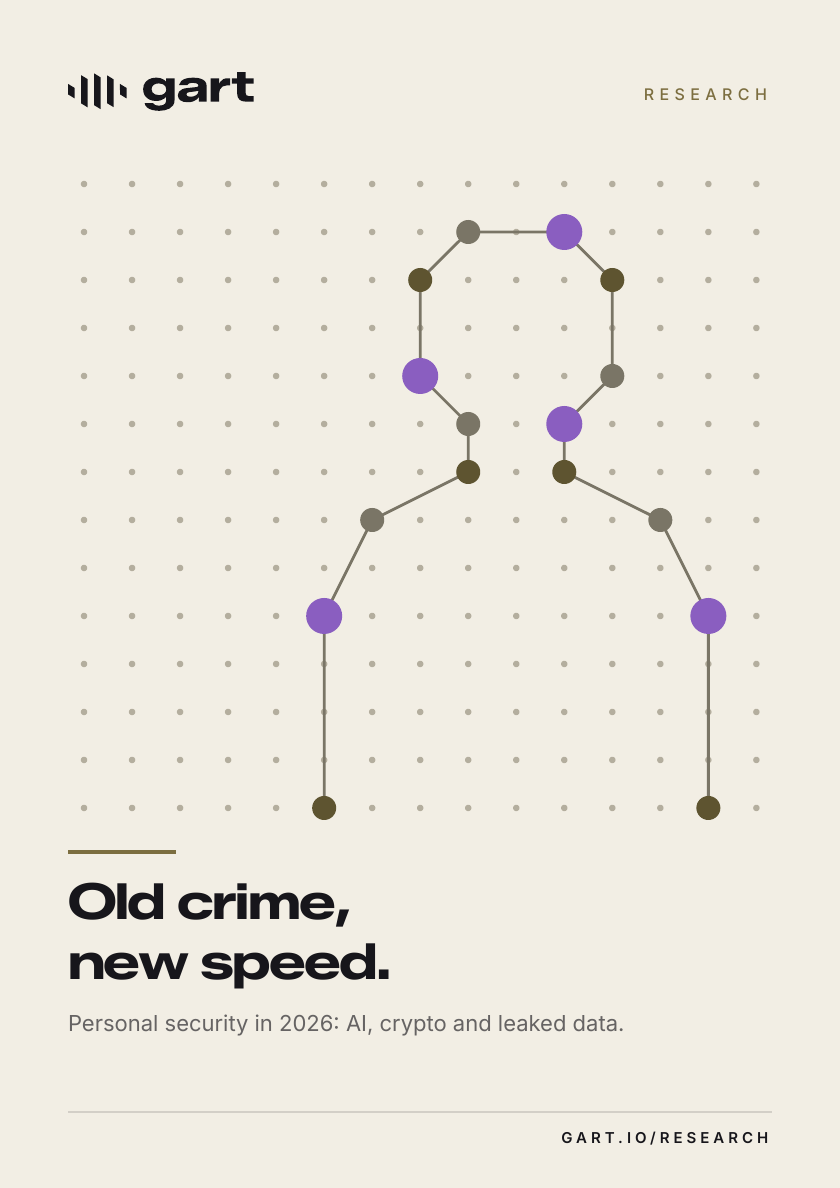
Title page of the latest Gart report, Old crime, new speed. Personal security in 2026: AI, crypto and leaked data.
Coming soon

Old crime, new speed. Personal security in 2026: AI, crypto and leaked data.

Our coming report looks at how AI and cryptocurrency change the threats a private person faces.

Privacy policy
Title page of the 2026 Gart report on kidnapping, ransom and physical attacks
February 2026

Kidnapping, ransom and physical attacks: challenges in cryptocurrency security.

A full analysis of documented physical attacks against cryptocurrency holders: how targets are selected, how incidents unfold, and what changes the outcome. PDF and EPUB.

Read the summary →
For researchers, policy makers and the press

Use the data.

Credit line

Source: gart.io

  • The records summarize public reporting. The linked articles belong to their publishers.
  • Tell us where you used the data if you can. We read what gets built on it and we correct what you find wrong.

API

  • Physical attacks
    sqlite-stats2.gart.io/api/cases
    Every case as JSON: date, country, location, description, summary, the labels of the four steps and source links.
  • It answers a plain GET without a key. How attacks unfold visualizes each attack in four steps.
Research method

Every entry links to its public source.

01

Public sources only

Every entry is a publicly reported incident with a link to its source.

02

Real numbers are higher

Many attacks and leaks are never reported. We estimate the real numbers are several times what the records show, so read every count here as a minimum.

03

Claims stay claims

Figures are the ones the company, the authorities or the researchers who found the data reported. What an attacker says is marked as a claim.

04

Four steps

We read every physical attack in four steps: targeting, how the attackers chose the victim; approach, how they got to the victim; attack, the type of attack; and outcome, how it ended and what the attackers obtained.

05

Labels

Each of the 4 steps has a fixed set of labels. A case can carry more than one label in each step, for example Attack: home invasion, followed by kidnapping.

06

Open to correction

If an entry is wrong or missing, write to us and we will check it against the sources.

Report a case or an error →
Glossary

The labels of the four steps.

01Targeting

Data leak
Customer database, tax-report or exchange leak.
Public records
Address or tax records obtained legally.
Insider
Someone with inside access (an employee, former employee, driver, guard, contractor, or bank or agency staff) passed on the victim's holdings or movements, or used that access to attack. Also a handler who supplied the target.
Organized by a relative or partner
A relative or partner of the victim organized or enabled the attack.
Acquaintance
A friend or social contact turned attacker.
Business counterparty
Prior trades, investors, a business or debt dispute.
Public profile
Known as a crypto holder: interviews, influencer status, executive role, rich lists.
Social media
Targeted after specific posts or streams.
Visible wealth
Cars, watches, spending or lifestyle seen offline.
Online contact or advert
The victim's ad or profile on a platform was answered.
Surveillance
Followed, watched, tracked.
Opportunistic
No prior selection.
Other
Anything else.
Unknown
The sources do not say how the victim was chosen.

Was the attackers' information right?

Correct
The victim held crypto or assets roughly as the attackers believed.
Wealth overestimated
The victim held far less than the attackers believed, or none.
Wrong person or address
The attackers hit someone other than the intended holder (moved out, previous owner, namesake).
Unknown
The sources do not let us tell.

02Approach

Social engineering: business or investment meeting
Social engineering: sale / purchase lure
A sale or purchase of something other than crypto.
Social engineering: dating or sexual lure
Social engineering: social invitation
Friend, party, dinner, night out.
Social engineering: pretext at the door
A story told at the door with no claimed role (damage to report, asking for someone).
Social engineering: other pretext
Social engineering: lure not described
The sources say the victim was lured and not how.
P2P trade
Any arranged meeting to exchange crypto or cash, whether or not the other side meant to trade.
Authority misuse: fake police or official
Authority misuse: serving police or official
Authority misuse: service ruse (delivery, driver, worker)
Includes fake taxis, fake rideshare and fake deliveries.
Authority misuse: other claimed role
Seized in the street or a public place
Seized at or outside the home
Grabbed at the door, gate, garage or car park of the home, without entry.
Taken from the workplace
Vehicle intercepted on the road
Walked in
Into a shop, exchange office or ATM site open to the public.
Forced entry
Into a home, hotel room, office or shop.
Let in by an insider
Break-in, nobody present
Remote, no contact
Unknown
The sources do not say how the attackers got to the victim.

Who was attacked

Counted in people. A case can name more than one person.

Holder
The person believed to hold the crypto or assets.
Relative or partner
Family or partner of the holder, attacked alongside the holder, as leverage, or in the holder's place. A couple or family attacked together is holder plus relative or partner.
Employee or guard
Staff of the holder or of a crypto business.
Wrong person or address
Someone attacked in place of the intended holder, usually because the attackers had an outdated address (previous owner or tenant).
Bystanders or neighbors
Others present who were not family or staff of the holder: friends, co-occupants, a neighbor, a passenger, customers in a shop.
Other
A person the other groups do not cover, or the sources do not say who it was.

03Attack

Kidnapping
The victim is taken away or held at a place the attackers control; pre-selected, or ransom asked of third parties.
Express kidnapping
Not pre-selected, seized in public, made to pay from own funds on the spot or in a vehicle. All three are needed.
Home invasion
Occupants held in their own home, hotel room or office.
Armed robbery
Theft by force with a weapon, no extended holding.
Robbery without a weapon
Theft by force or assault, no weapon reported.
Mugging
Opportunistic street robbery.
Burglary
Theft from premises, a machine or an empty home, nobody confronted.
Extortion without detention
Threats in person or remote, nobody held.
Theft by deception
No force used.
Swatting
A false emergency report sends armed police to the victim.
No label fits
The sources describe an attack none of our labels covers.

Violence used

Detention
Anyone was held against their will, restrained or prevented from leaving, for any length of time: the holder, a relative, staff or a guard.
Violence or torture
Physical violence against a person: beaten, stabbed, shot, burned, tasered or tortured, or injured in the attack. Restraint is detention, a weapon only carried is weapons, and drugging is drugs or alcohol.
Weapons
A weapon was present or used: a firearm, knife, taser, pepper spray, or any object used as a weapon, a car included. Fists do not count, and neither do ties or tape used only to tie someone up.
Drugs or alcohol
The attackers used a drug or alcohol on the victim: a spiked drink, a sedative, an injection or forced drinking. The victim's own drinking does not count.

Values of violence used

Each of the four takes one value. The four steps count Yes only.

Yes
The sources report it as fact.
No
It surely did not happen: the sources say so, or the account rules it out (nobody was present).
Threat only
Violence or torture only. Threats of harm were made, such as a weapon pointed or a threat against the family, and no physical violence is reported.
Unconfirmed
A source asserts, alleges or charges it, or the sources disagree, and it is not established.
Unknown
The sources do not say, or say it was not disclosed. A flag the sources are silent on is Unknown, never No.

04Outcome

Foiled
Stopped before the attackers gained control of anyone. An attack that got no assets after holding or hurting someone is not foiled; see what the attackers obtained.
Escaped
The victim got away from the attackers by their own action (ran, jumped, slipped away).
Fought off
The victim, or someone with them, resisted physically and the attackers gave up and fled.
Rescued
Freed by police or other people.
Released
The attackers let the victim go, or left.
Killed
The victim died.
Victim missing
The victim has not been found, and neither a death nor a release is confirmed.
Nobody held or hurt
Burglary, swatting, remote cases.
Unknown
The sources do not say what happened at this step.

What the attackers obtained

Crypto
Cash
Devices or seed
Valuables
Nothing
Unconfirmed
A taking is alleged or charged and not established, or the sources disagree.
Unknown
The sources do not say what, if anything, the attackers got.