
Why Gart Exists
The world is becoming increasingly unpredictable, and new technologies are creating new challenges to physical security. Cryptoassets and AI have reshaped how wealth is held, moved, and exposed - but the security frameworks protecting the people behind that wealth have not kept pace.
Since 2014, over 300 documented physical attacks have targeted cryptocurrency holders worldwide, including kidnappings, home invasions, and armed robberies. 2025 saw a 77% increase over the prior year, and an estimated 60% or more of incidents go unreported entirely.
Documented cases already include victims who held no cryptocurrency at all - forced under duress to open exchange accounts and transfer fiat savings into crypto for immediate extraction by their attackers. This is an unsettling indicator that cryptocurrency may become the preferred rail for extracting any kind of digital wealth, including traditional bank deposits. The threat is not confined to crypto holders. It extends to anyone whose wealth, role, or data footprint makes them identifiable and valuable.
Executives and corporate leaders face kidnapping and extortion risks that scale with their public visibility. Compensation disclosures, media profiles, and travel patterns create targeting opportunities that most corporate security programs overlook.
High-net-worth and ultra-high-net-worth individuals are increasingly exposed through property records, court filings, and aggregated wealth signals that are trivially easy for criminal networks to compile.
Cryptoasset investors are naturally (and currently) the most acutely targeted group for cryptocurrency. Centralized exchanges and custodians have suffered massive customer data breaches. Every KYC database is a future targeting list, and the finality of digital asset transactions means there is no chargeback, no reversal, no recovery once assets are surrendered under duress.
Exposed individuals and public speakers - those whose personal data has been compromised through breaches, doxxing, public records, or simply a publicly facing occupation - carry elevated risk regardless of their net worth.
Globally mobile professionals - those living and working across multiple jurisdictions - face compounded risk. Unfamiliar environments, inconsistent law enforcement, and the absence of local support networks make them particularly vulnerable.
Despite the escalation, there is a stark lack of education and training addressing the specific risks of cryptocurrencies being used as a ransom and extraction mechanism. Most security programs were designed for a pre-crypto world and do not account for the speed, irreversibility, and coercion dynamics unique to digital assets.
At the same time, there are no adequate privacy-preserving tools for fast emergency response. Existing solutions either depend on constant surveillance, rely on a vendor's infrastructure, or create new data honeypots - none of which respect the user's privacy while delivering autonomous, covert alerting when it matters most.
Gart was founded to close these gaps. We operate across two pillars: research and training.
Gart Research
Informed protection starts with understanding the threat.
stats.gart.io is the world's most comprehensive database of physical attacks on cryptoasset holders. Built upon and expanding Jameson Lopp's foundational archive, it tracks, classifies, and analyzes every documented case, mapping criminal methodologies, identifying emerging hotspots, and surfacing patterns across jurisdictions.
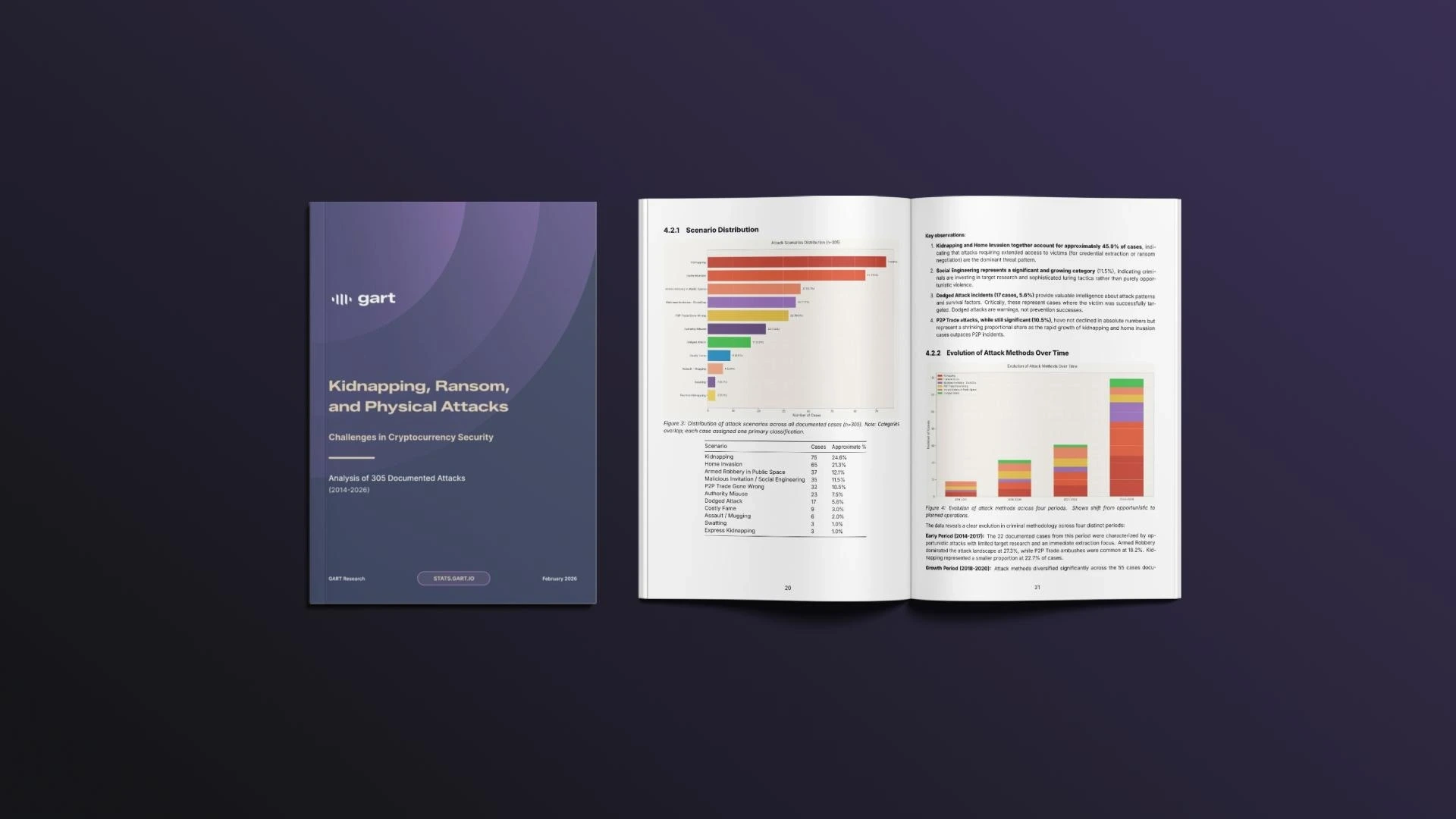
In early 2026, we published our first research paper: Kidnapping, Ransom, and Physical Attacks: Challenges in Cryptocurrency Security. It is the first comprehensive quantitative analysis of this threat, covering 305 documented cases across more than a decade. The paper examines attack scenarios, violence indicators, geographic distribution, targeting vectors, and the evolving criminal methodologies behind these attacks. Key findings include the dominance of kidnapping and home invasion as primary scenarios, the sharp rise of social engineering-driven attacks, and the direct link between regulatory data collection, exchange breaches, and subsequent physical violence.
This intelligence foundation informs everything we do, from our training curriculum to the response protocols we build with our clients.
Gart Training & Advisory
Knowledge alone is not enough. Under stress, people fall back to their level of training, not reading.
Gart delivers hands-on security training and counter-kidnapping preparedness for families and teams who face elevated physical risk. Our programs are conducted by seasoned security professionals with decades of combat and close protection experience - people who have managed extreme situations and protected clients in hostile environments around the world.
Training covers anticipation and avoidance of threats from kidnappers, thieves, and hostile surveillance, along with response protocols, travel security planning, and operational security strategies tailored to each client's specific risk profile.
Our programs include:
- Counter-kidnapping preparedness - the first training of its kind designed specifically for high-value crypto investors and their families
- Family security protocols - practical frameworks that prepare households, including partners and children, for threat scenarios
- Executive and team training - tailored sessions for corporate leadership, family offices, and close protection teams operating across jurisdictions
- Custom threat assessments and response protocols - individualized analysis of exposure, vulnerabilities, and recommended countermeasures
To start improving your security posture today, learn more about our training programs here.
Looking Ahead
This announcement covers the first two pillars of Gart. More is coming.
Security is not about living in fear. It is about preparation, awareness, and the confidence that comes from knowing you and your family are ready. Gart gives you the tools and protocols to move through the world on your terms.
Alena Vranova - Founder at Gart
previously co-founder at SatoshiLabs/Trezor, creator of Casa Node, author of The Little Bitcoin Book